
by Joey deVilla on May 9, 2010
Every field comes up with its own jargon, and oftentimes subgroups within a field come up with their own specific words or phrases (those of you familiar with Microsoft Canada’s Developer and Platform Evangelism Team know that we have our own term for “broken”, named after one of our teammates who is notorious for killing all sorts of tech gear).
A question recently posted on Stack Overflow asked for people to submit programming terms that they or their team have coined and have come into regular use in their own circles. I took a number of the submissions and compiled them into the alphabetically ordered list below for your education and entertainment.
Have you come up with your own jargon? Tell us in the comments!
Banana Banana BananaPlaceholder text indicating that documentation is in progress or yet to be completed. Mostly used because FxCop complains when a public function lacks documentation.
Example:
/// <summary> /// banana banana banana /// </summary> public CustomerValidationResponse Validate(CustomerValidationRequest request, bool ... Barack ObamaA project management account to which the most aspirational tickets – stuff you’d really like to do but will pobably never get approval for – gets assigned.
BicrementAdding 2 to a variable.
BloombugA bug that accidentally generates money. [Joey’s note: I have never written one of these.]
Bugfoot
A bug that isn’t reproducible and has been sighted by only one person. See Loch Ness Monster Bug.
Chunky SalsaA single critical error or bug that renders an entire system unusable, especially in a production environment.
Based on the chunky salsa rule from TVTropes: Any situation that would reduce a character’s head to the consistency of chunky salsa dip is fatal, regardless of other rules.
Configuration Programming / ProgrammerSomeone that says they are a programmer but only knows how to hack at configuration files of some other pieces of software configuration to make them do what they want.
CounterbugA defensive move useful for code reviews. If someone reviewing your code presents you with a bug that’s your fault, you counter with a counterbug: a bug caused by the reviewer.
DOCTYPE DecorationWhen web designers add a proper DOCTYPE declaration at the beginning of an HTML document, but then don’t bother to write valid markup for the rest of it.
Drug ReportA bug report so utterly incomprehensible that whoever submitted it must have been smoking crack. The lesser version is a chug report, where the submitter is thought have had one too many.
Duck
A feature added for no other reason than to draw management attention and be removed, thus avoiding unnecessary changes in other aspects of the product.
This started as a piece of Interplay corporate lore. It was well known that producers (a game industry position, roughly equivalent to PMs) had to make a change to everything that was done. The assumption was that subconsciously they felt that if they didn’t, they weren’t adding value.
The artist working on the queen animations for Battle Chess was aware of this tendency, and came up with an innovative solution. He did the animations for the queen the way that he felt would be best, with one addition: he gave the queen a pet duck. He animated this duck through all of the queen’s animations, had it flapping around the corners. He also took great care to make sure that it never overlapped the “actual” animation.
Eventually, it came time for the producer to review the animation set for the queen. The producer sat down and watched all of the animations. When they were done, he turned to the artist and said, “That looks great. Just one thing – get rid of the duck.”
Fear-Driven DevelopmentWhen project management adds more pressure, such as by firing a member of the team.
Ghetto Code
A particularly inelegant and obviously suboptimal section of code that still meets the requirements. [Joey’s note: I’ve written ghetto code before, but that’s because I’m street, yo!]
HindenbugA catastrophic data-destroying bug. Oh, the humanity!
Hocus Focus ProblemUnexpected behavior caused by changes in focus, or incorrect setting of focus. Could also be used to describe an app stealing your focus.
Hot Potato / Hot PotatoesA fun way to pronounce http:// and https://.
IRQedAnnoyed by interruptions. Pronounced like and has a similar meaning to “irked”.
Jimmy
A generalized name for the clueless/new developer. The submitter at Stack Overflow writes:
We found as we were developing a framework component that required minimal knowledge of how it worked for the other developers. We would always phrase our questions as: “What if Jimmy forgets to update the attribute?”
This led to the term “Jimmy-proof” when referring to well designed framework code.
It’s probably best not to use this term around IronRuby developer Jimmy Schementi.
Loch Ness Monster BugA bug that isn’t reproducible and has been sighted by only one person. See Bugfoot.
MegamothMEGA MOnolithic meTHod. Usually stretches over two screens in height and often contained inside a God Object (an object that knows or does too much).
.NET SandwichWhen .NET code called native code which calls other .NET code and makes the poorly designed application crash.
n-gletonA class that only allows a fixed number of instances of itself.
NOPpingNot napping, but simply zoning out. Comes from the assembly language instruction NOP, for No OPeration, which does nothing.
Pokemon Exception HandlingFor when you just gotta catch ’em all!
Reality 101 Failure
The program (or more likely feature of a program) does exactly what was asked for, but when it’s deployed it turns out that the problem was misunderstood and the program is basically useless.
RefuctoringThe process of taking a well-designed piece of code and, through a series of small, reversible changes, making it completely unmaintainable by anyone except yourself. It’s job security!
The SheathThe isolating interface between your team’s (good) code, and the brain-dead code contributed by some other group. The sheath prevents horrible things (badly named constants, incorrect types, etc.) in their code from infecting your code.
[Joey’s note: I’ve heard the term “shim” used for this sort of construct. I’ve used the term “transmogrifier” for this sort of thing.]
Shrug ReportA bug report with no error message or “how to reproduce” steps and only a vague description of the problem. Usually contains the phrase “doesn’t work.”
Smug ReportA bug report submitted by a user who thinks he knows a lot more about the system’s design than he really does. Filled with irrelevant technical details and one or more suggestions (always wrong) about what he thinks is causing the problem and how we should fix it.
Stringly-Typed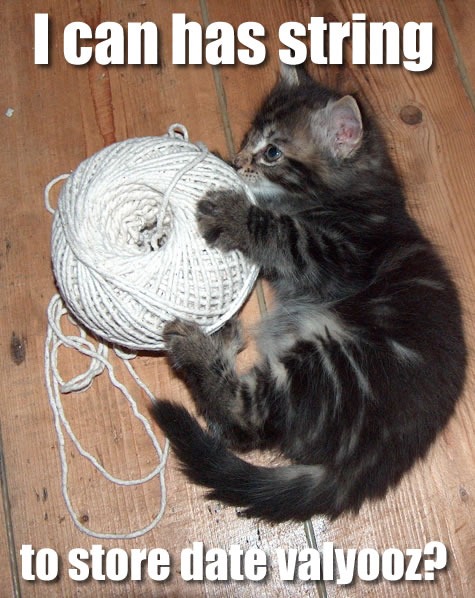
A riff on strongly-typed. Used to describe an implementation that needlessly relies on strings when programmer- and refactor-friendly options are available.
Examples:
- Method parameters that take strings when other more appropriate types should be used
- On the occasion that a string is required in a method call (e.g. network service), the string is then passed and used throughout the rest of the call graph without first converting it to a more suitable internal representation (e.g. parse it and create an enum, then you have strong typing throughout the rest of your codebase)
- Message passing without using typed messages etc.
Excessively stringly typed code is usually a pain to understand and detonates at runtime with errors that the compiler would normally find.
UnicornyAn adjective to describe a feature that’s so early in the planning stages that it might as well be imaginary. This one comes from Rails Core Team member Yehuda Katz, who used it in his closing keynote at last year’s Windy City Rails to describe some of Rails’ upcoming features.
Yoda Conditions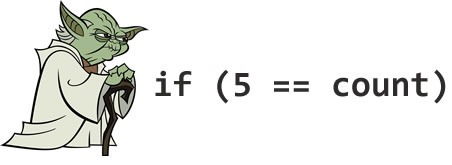
The act of using
if (constant == variable)instead of
if (variable == constant)It’s like saying “If blue is the sky”.
Article copied from: http://www.globalnerdy.com/2010/05/09/new-programming-jargon/


